The Importance of Internal Linking for SEO and AI Search
Every SEO knows how important links are. External links to your site (backlinks) can help your website get discovered, crawled and indexed by search engines, but they are not always easy to earn or control. Citations are all the rage, but being seen as the expert in a field is very hard and the competition is fierce across all UK sectors.
Internal links are different. They are completely within your control, which means you can decide which pages to link to, where those links appear and what anchor text you use. There are three parts to internal links, quantity (number of times a page is linked from other pages outside of the menu or other template aspects), the variation of anchor text, and the variation of url (ie adding anchors: egL domain.co.uk/main-page#read)
That makes internal linking one of the simplest ways to help Google and the likes of ChatGPT understand your website. Search specialists such as Peacock Search also highlight internal linking as an important area to check when improving a site’s SEO.
A good internal link should point users towards something genuinely useful and relevant. It might take them from a blog to a related service, from one guide to another, or from a supporting article back to an important main page. Randomly adding links on unrelated pages is nonsensical.
The anchor text matters too. Rather than using vague phrases such as “click here”, it is usually better to use wording that gives a clear idea of what the linked page is about. This helps visitors and also gives search engines more context about the relationship between the two pages. However, there is always a balance between generic anchor text and SEO friendly anchor text. The second can make your page look spammy. Also, the number of internal links to a page shows how important it is in the site. This is often why the home page of a website ranks over other pages in search results.
- Google covers this in its link best practices.
Internal Linking and AI
Internal linking is also useful as search becomes more influenced by AI.
AI-powered search systems need to understand how the information on a website fits together. Clear internal links can help show which pages cover similar topics, which pages provide more detail and which content is most important.
- This is increasingly forming part of AI SEO and generative engine optimisation strategies. UK agencies such as Propeller include internal linking alongside crawlability, sitemaps and other technical improvements when optimising websites for AI search.
For example, if you have a main service page supported by several blogs, guides and FAQs, linking those pages together creates a much clearer topic structure.
It is useful for visitors too. Someone reading an article can naturally move on to a related service or another useful piece of content without having to search for it themselves.
Google recommends using a logical site structure and linking important pages from other relevant pages. Its guidance on sitelinks and site structure explains this in more detail.
Types of Internal Links
There are several types of internal links worth considering.
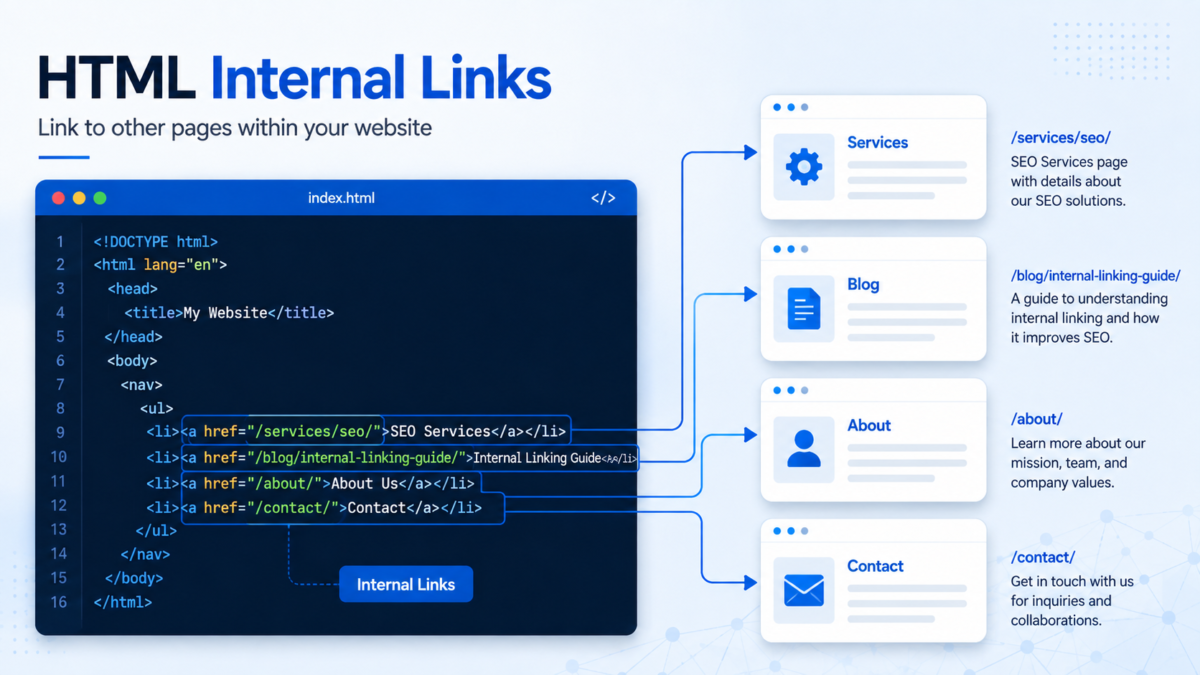
- Navigation Links – Your main navigation should make important areas of the website easy to find. Wherever possible, important pages should be linked using normal crawlable HTML links.
- Footer Links – Footer navigation can be useful for linking to important sections, contact information and other key pages. It should stay useful rather than becoming a long list of keyword-heavy links.
- Inline Text Links – These are often the most useful internal links because they sit naturally within relevant content. They give visitors somewhere logical to go next and help search engines understand how two pieces of content are connected.
- Sitemap Links – An HTML sitemap can help visitors find important pages, while an XML sitemap helps search engines discover URLs across the site. Google has further information in its crawling and indexing guidance.
Strong Topic Connections
One of the best ways to use internal linking is to connect related content together.
A service page could link to supporting blogs and guides, while those blogs link back to the relevant service page. Other related articles can also link between each other where it makes sense. This can be done by creating categories and adding the correct category blogs to the right service or product page. Elementor can do this really easily.
This creates a stronger topic cluster rather than leaving pages sitting on their own.
The same principle is increasingly being applied to AI search. UK GEO agency Tilio includes improved internal linking and supporting content among the ways websites can make their information clearer for AI-powered search systems.
It can also help prevent orphan pages, which are pages that have few or no internal links pointing to them. Even useful content can be difficult for search engines and visitors to find if nothing else on the site links to it.
Internal Links and AI Search
The same basic principles still apply as Google introduces more AI-driven search features.
Google says that the usual SEO fundamentals continue to apply to AI Overviews and AI Mode. There is no separate trick required. Content still needs to be accessible, useful and easy for Google to understand.
You can read more in Google’s guidance on AI features and your website and its guide to optimising for generative AI features.
Other UK SEO agencies are taking a similar approach. First Internet includes tightening internal linking within its AI SEO work, alongside content and technical improvements. In a local SEO sense, internal links are doubly important. A good example is https://helloguest.co.uk/locations. This has internal links, which is a perfect example of internal linking boosting geo-targeted SEO:
- https://helloguest.co.uk/locations/england/london
- https://helloguest.co.uk/locations/scotland/edinburgh
- https://helloguest.co.uk/locations/england/airbnb-management-merseyside/liverpool
- https://helloguest.co.uk/locations/england/sussex/brighton
Likewise, Converted considers internal linking alongside technical accessibility, entity clarity, structured data and topical depth when assessing visibility across AI search.
Internal linking is only one part of SEO, but it is an important one.
- Combined with useful content, good site structure and a strong external linking strategy, it can make important pages easier to find, easier to understand and easier for visitors to navigate.
- The aim is not to add internal links everywhere. It is to add them where they are genuinely useful and where there is a clear relationship between the two pages.
- Done properly, internal linking can improve the structure of your site, support traditional SEO and make your content easier for modern search and AI systems to understand.